Appearance
Zettelkasten vs PARA: Two Systems for Two Different Questions
Two tutorials, one weekend
Suppose you set aside a weekend to finally organize your notes, and you read two well-regarded tutorials first.
The first tells you to make four folders: Projects, Areas, Resources, Archives. Everything you save goes into whichever folder matches what you are working on. When a project ends, its folder moves to the archive. It is clear, quick to set up, and you can picture your notes being tidy by Sunday evening.
The second tells you to write each idea on its own small note, in your own words, and link it to the notes it relates to. Nothing gets filed by subject. Over time, the links form a network you can think with. It is slower to set up and harder to picture, and the man it is usually traced back to described his as a partner he could talk to, not a filing cabinet.
Both tutorials are confident, and they seem to be telling you to do opposite things. One sorts your notes into four boxes. The other refuses to sort them at all. So which one is right?
Same rejection, different reasons
Here is something the two methods have in common, and it is a good place to start: both reject the most familiar way to organize notes, which is by topic.
Tiago Forte, who described PARA, puts it this way: instead of "organizing information according to broad subjects like in school, I advise you to organize it according to the projects and goals you are committed to right now. This is what it means to 'organize by actionability'" (Forte, The PARA Method).
Niklas Luhmann, the sociologist whose slip box is the one most people mean by "Zettelkasten," wrote in 1981 that "we decide against the systematic ordering in accordance with topics and sub-topics and choose instead a firm fixed place." His reason: a system based on content "would mean that we make a decision that would bind us to a certain order for decades in advance!" (Luhmann, Communicating with Slip Boxes).
They turn away from the same thing and walk off in different directions. Forte replaces topics with what you are doing. Luhmann replaces them with fixed positions and links, so that ideas can connect in ways no table of contents would have planned.
That difference is the whole story. The two methods are not rival answers to one question. They answer two different questions:
- PARA answers: what do I need for the work in front of me? It is built around action, and it is at its best when you sit down to work on a specific project and want everything for it in one place.
- A Zettelkasten answers: what do I think about this idea, and what does it connect to? It is built around ideas, and it is at its best when you are trying to develop an argument that no single project contains.
Plenty of people who take notes seriously have both questions. The rest of this article looks at each method in its author's own words, then at where they really differ, and then at how to run both without one undoing the other.
PARA, in Forte's words
The page this section draws on is Forte's own description of the method, published on his site as an excerpt from his book; it refers to itself as "this book" (Forte, The PARA Method). It presents PARA as "a simple, comprehensive, yet extremely flexible system for organizing any type of digital information across any platform."
It rests, in Forte's words, on "a simple observation: that there are only four categories that encompass all the information in your life":
- Projects: "short-term efforts (in your work or personal life) that you take on with a certain goal in mind," such as completing a webpage design or renovating the bathroom.
- Areas of responsibility: "important parts of your work and life that require ongoing attention," such as marketing or direct reports at work, and health or finances at home.
- Resources: "a range of topics you're interested in and learning about," such as graphic design, organic gardening or habit formation.
- Archives: "anything from the previous three categories that is no longer active, but you might want to save for future reference," including projects completed or put on hold.
Each of the four is a top-level folder, "each containing a small number of subfolders dedicated to each active project, area of responsibility, resource, and archive in your life."
Forte's reason for the design has two parts. The first is simplicity: "if your organizational system is as complex as your life, then the demands of maintaining it will end up robbing you of the time and energy you need to live that life." The second is the principle quoted earlier. He writes that most of us learned to organize "by academic subject" at school and carried the habit into adult life, where "there are no classes, no tests, no grades, and no diplomas." What adults have instead "are outcomes you are trying to achieve." So material should sit where the work that needs it happens: "When you sit down to work on a graphic design project, for example, you will need all the notes, documents, assets, and other material related to that project all in one place and ready to go."
The slip box, in Luhmann's words
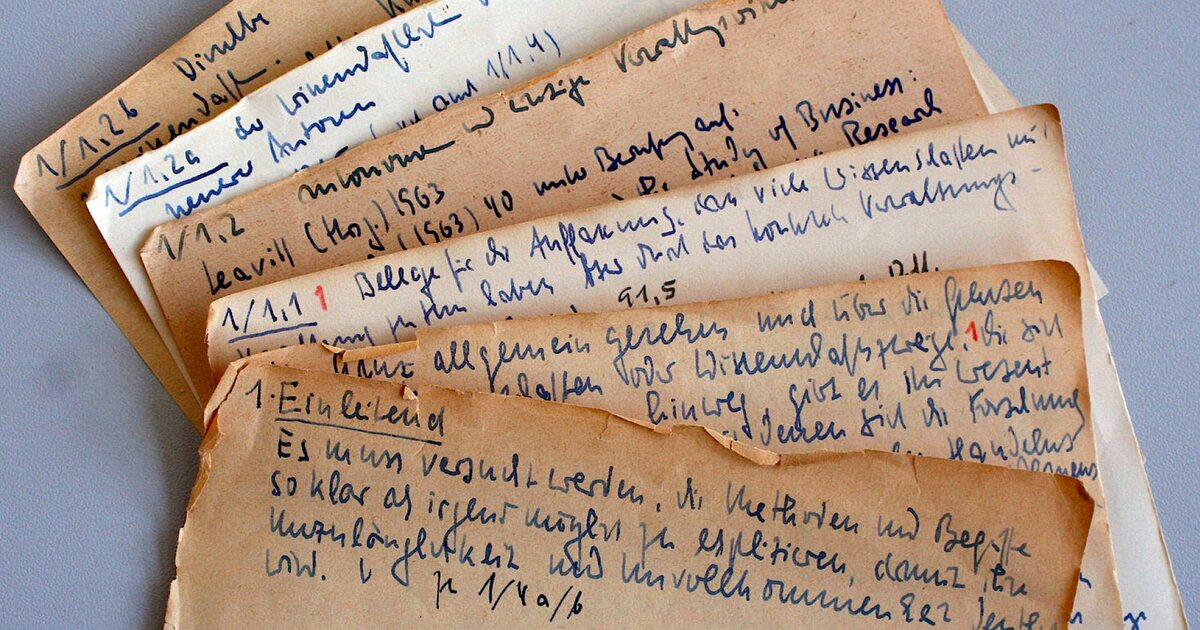
Luhmann's essay, "Communicating with Slip Boxes," calls itself "a piece of empirical sociology" about "me and someone else, namely my slip box" (English translation by Manfred Kuehn). An earlier article covers its history and numbering in more detail. Four points from it matter for this comparison.
Writing is where the thinking happens. "It is impossible to think without writing; at least it is impossible in any sophisticated or networked (anschlußfähig) fashion."
Every note has a fixed address, and new notes branch from old ones. Having chosen a "firm fixed place" over a topical order, Luhmann gives each slip a number that never changes. New notes do not have to go at the end: "we can connect them anywhere—even to a particular word in the middle of a continuous text." A slip numbered 57/12 can be continued by 57/13, and a thought inside it can be developed on 57/12a, and so on.
Links matter more than placement. Because every slip keeps its number, "you can add as many references to them as you may want." Then comes a sentence worth reading twice: "Given this technique, it is less important where we place a new note. If there are several possibilities, we can solve the problem as we wish and just record the connection by a link." He adds: "Central concepts can have many links which show on which other contexts we can find materials relevant for them."
A small register, kept up to date. Since there is no systematic order to fall back on, "we need a register of keywords that we constantly update," which points into the box by slip number.
And the purpose behind it all is a conversation. Slip boxes, Luhmann writes, "can be recommended as partners of communication," and he spells out what that requires: "One of the most basic presuppositions of communication is that the partners can mutually surprise each other."
What I take from the two texts
That is what the two authors say. The rest of this article is my reading of how their methods relate.
Read side by side, the two texts put their effort in opposite places. In PARA, the decision that matters is where a piece of material goes. Put it in the right project folder and it is there, ready, when you sit down to do the work. In Luhmann's slip box, he says outright that where a note goes is the less important decision. What matters is what it connects to, recorded as a link from one fixed address to another.
So the two methods ask you a different question every time you save something. PARA asks: where does this go? The slip box asks: what does this connect to? Each question produces a different kind of collection over time, and each fails in its own way. That is the subject of the next section.
Where they really differ
This section is my analysis, built on the two texts above. Four differences follow from the question each method asks.
What a unit is
In PARA, the unit is a folder of material for one purpose: a project, an area, a topic. What goes inside can be anything, from a document or a screenshot to a meeting note or a saved article. The folder is defined by what it is for, not by what is in it.
In the slip box, the unit is a single note with a fixed address, holding something you wrote. Luhmann's point that "it is impossible to think without writing" is what makes the note the unit: the thinking happens in the act of writing it. He even notes that excerpts copied from reading are "only useful in the case of especially remarkable formulations."
The difference shows up the first time you save something. A PARA folder accepts a saved article as it is. A slip box needs you to read the article and write down what you made of it.
Whether things move
PARA expects material to move. A project is defined as "short-term," and when it ends its folder goes to the archive. Resources you lose interest in go there too. The structure follows your life, which is exactly the point: the folders in front of you are always the ones that matter now.
The slip box expects nothing to move. Luhmann gives each slip a number that never changes, so that a link written ten years ago still points to the right place. The structure follows the ideas. What changes over time is not where notes are but what they are connected to.
Each of these is a strength for its own question. When you are working on a project, you want the material for the project around you and everything else out of sight. When you are developing an idea, you want every note that bears on it to stay reachable, including ones written for projects that ended long ago.
Where knowledge accumulates
In PARA, what you learn tends to end up inside the work. A finished project contains the research, the drafts and the decisions that went into it. When the project moves to the archive, that knowledge moves with it, kept safe and organized by the project it served.
In the slip box, what you learn ends up in the notes and in the links between them. A note written for one purpose keeps being linked from new ones, so an idea from an old piece of work is still part of the network when a new one needs it. That is what Luhmann meant by a partner of communication: one that can still surprise you.
How each one fails
Every system has a way of going wrong that follows from what it is good at.
PARA's four categories say where saved material goes. On their own, they do not ask what you think about it. The risk is a Resources folder that keeps growing: articles saved for later, topics you meant to read up on, all in the right place and none of them turned into anything. The folder is organized and still inert. When the project that needed some idea ends, the idea goes to the archive with it, and you find it again only if you remember which project it belonged to, or search for the right words.
The slip box's risk is the opposite. Because nothing in it is tied to a deadline, it can grow for years as a network of well-written, well-linked notes that never become a finished piece of work. And because every note has to be written, not just saved, it is slow. Under deadline pressure, it is the first habit to go.
| PARA | Slip box | |
|---|---|---|
| The question it asks | Where does this go? | What does this connect to? |
| Unit | A folder of material for one purpose | One idea, written as a note |
| Over time | Folders move as projects start and end | Notes never move; links accumulate |
| Knowledge ends up | Inside the projects it served | In the notes and the links between them |
| Typical failure | Saved but never processed | Connected but never finished |
Read the last row again. Each method's failure is the other's strength. PARA is good at turning material into finished work. The slip box is good at turning material into ideas that last beyond any single piece of work. That suggests the obvious move, which the next section takes: not choosing between them, but giving each one the job it was designed for.
Running both: containers for action, links for ideas
The two methods stop competing once each gets its own layer. Use containers, in the PARA sense, for what you are doing. Use links, in the slip-box sense, for what you are thinking. A note can live in a project folder and still be part of the network of ideas, as long as moving the folder does not cut the links.
That last condition is the one that breaks most combinations. In PARA, archiving means moving. In a slip box, moving is the one thing that must not damage anything. So the rule that makes the two work together is simple to state: let containers change as your work changes, and never let that change touch your links.
In Jotaid
Here is how that division works in Jotaid, the app I build, following its own guides to PARA and the Zettelkasten.
The PARA layer is made of containers. Jotaid has two levels of container, projects and themes, so the four categories map onto them like this:
- Projects become projects: anything with an end gets its own scope.
- Areas become a project, or a theme inside a larger one if a lighter structure is enough.
- Resources stay in the Inbox, findable through tags and links, instead of being filed.
- Archives become a tag,
archived, not a place.
The slip-box layer is made of concepts. Writing [[attention residue]] in a note creates a concept with a page of its own, and that page lists every note that mentions it. The Jotaid guide calls these concepts "Luhmann's keyword cards." There is one difference worth knowing. Luhmann kept his register by hand, and as the earlier article describes, it never tried to list every slip. Jotaid's concept list builds itself from your links, and each concept lists all the notes that cite it, so the work Luhmann did by hand happens as you write. Each concept also has a body of its own, where you write what you currently think it means.
The surprise Luhmann wanted from his slip box has a direct counterpart too. The co-occurrence matrix shows which concepts keep turning up in the same notes, including pairs you never linked to each other, and link predictions point to pairs that have never met but sit close together in the network. As the Zettelkasten guide puts it, two concepts that recur across the same notes yet were never directly related are "very often, the title of your next permanent note."
The one rule: archive with a tag, not a move
Here is the point where the two methods would collide, and how the guide resolves it.
In Jotaid, the graph and the co-occurrence matrix work within the current project. So if you archive the PARA way, by moving finished notes into an "Archive" project, those notes disappear from the network of the project they came from. The PARA guide is blunt about it: moving notes into an archive project "makes them vanish from your graph." It goes on: "An archived note may still be a load-bearing piece of evidence for some concept; moving it away severs that thread."
The fix is to archive with a tag instead. Mark finished notes archived and leave them where they are. The links, the concepts and the matrix stay intact, which is exactly what the slip box needs. The tag does not hide anything, though. Jotaid's tag filter narrows a list to the notes that carry a tag, so archived notes still appear in your everyday lists. What the tag gives you is the whole finished batch, one filter away whenever you want it back. That is a trade: a little of PARA's tidiness, in exchange for a network that stays whole.
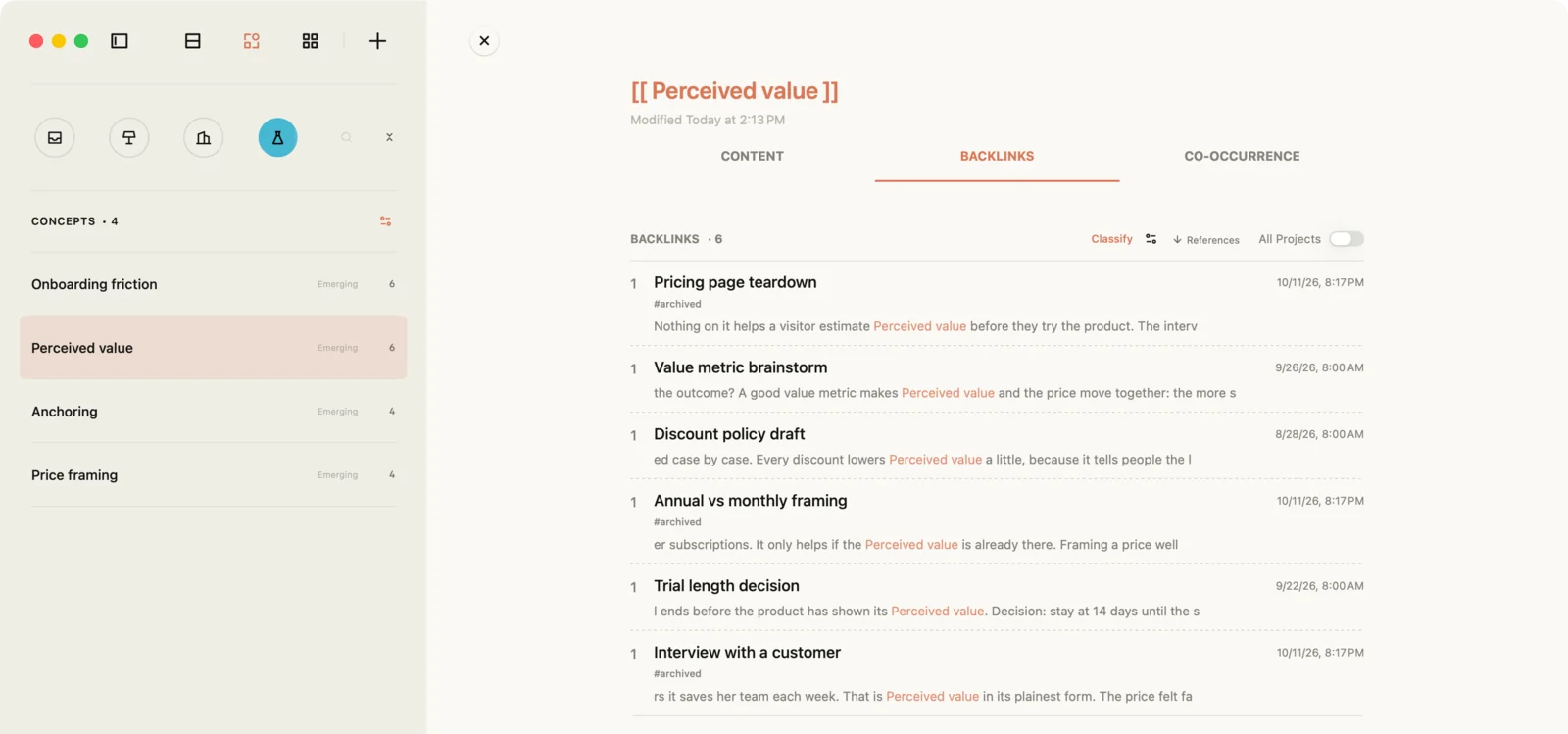
#archived: the customer interview, the pricing page teardown and an early framing note. They stay where they were, and all six still count as evidence for the concept.The same reasoning applies to projects themselves. Because each project has its own network, work that shares ideas belongs in the same project. A research direction you will keep returning to is better as one long-running project with a theme for each line of work than as a new project for every deliverable, which would split its ideas into separate networks. Use themes as the direction you are currently pushing on, not as a classification tree. The Zettelkasten guide puts the warning plainly: "the moment you start agonising over which folder a note belongs in, the network has degenerated into a tree."
One practical note. Jotaid's free tier is one project, the Inbox, with every feature inside it. That happens to suit this approach well: everything stays in a single network, themes give the work its structure, and the archived tag does the archiving. Separate projects need Pro, and the free tier filters by one condition at a time (Free vs Pro).
Which one do you need?
Go back to the two questions, and ask which one you actually face.
PARA alone is enough if your notes mostly serve the work in front of you: projects with deadlines, responsibilities to keep track of, reference material you look up. If you rarely find yourself wanting an idea from last year's project for this year's, the slip box would be upkeep with little return.
A slip box alone may be enough if your work is one long line of thinking: a researcher in one field, a writer returning to the same subjects, anyone whose outputs grow out of a body of ideas rather than a series of separate projects. Luhmann worked with his from 1952 until his death in 1997.
Both is the answer if you do project work and also think across it. The projects need PARA's focus. The ideas that outlive any one project need the slip box. The combination works as long as archiving never breaks a link.
What this doesn't solve
Neither method does the thinking. PARA puts the right material in front of you. A slip box keeps ideas connected. Neither writes the report or the argument, and neither tells you whether an idea is any good.
The mapping into Jotaid is not one to one. PARA has four folders. Jotaid has two levels of container plus tags, so Areas and Resources become a judgment call between a project, a theme and a tag. The Jotaid PARA guide gives a starting point, not a rule.
Project scope cuts both ways. Keeping each project's network separate keeps it focused, and it also means ideas in different projects do not meet in the graph or the matrix. If two lines of work feed each other, keep them in one project.
A slip box takes time you may not have. The cost is real, and no app removes the need to write the notes.
Back to the weekend
The two tutorials were both right. They were answering different questions.
PARA answers what do I need for the work in front of me?, and it answers it well: four folders, material where the work is, archives out of the way. The slip box answers what do I think, and what does it connect to?, and it answers that well too: notes at fixed addresses, links that last longer than any project.
If you only have one of those questions, use the method that answers it. If you have both, give each method its own layer, and keep the one rule that lets them live together: containers can change as your work changes, but links stay where they are.
Frequently asked questions
Can you use PARA and a Zettelkasten together?
Yes, if each does a different job. Use PARA's containers for active work and a slip box's links for ideas. The point where they collide is archiving: PARA archives by moving material, and moving notes can cut the links a slip box depends on. Archiving with a tag instead of a move keeps both intact.
What is the difference between PARA and a Zettelkasten?
PARA, described by Tiago Forte, sorts material into four folders, Projects, Areas, Resources and Archives, according to what you are working on. A Zettelkasten, in the form Niklas Luhmann described, gives each note a fixed place and connects notes by links, so ideas can relate in ways no folder structure planned. PARA answers "what do I need for this work?"; a Zettelkasten answers "what does this idea connect to?"
Do I need Luhmann's numbering in a digital note app?
Usually not. Luhmann's numbers gave each paper slip a fixed address so links could point to it. In a digital app, a note's title or identity serves as the address, and links work without a numbering scheme. What carries over is the principle: a note should stay findable from every link that points to it, wherever it sits.
How do I archive notes without breaking links?
Mark them as archived instead of moving them. A tag such as archived keeps finished material one filter away while every link and concept stays where it was. In Jotaid the tag does not hide those notes from your lists, but it keeps them in the network, and that matters because the graph and matrix work within a project, so notes moved to another project leave the network they belonged to.
Is PARA or a Zettelkasten better for researchers?
It depends on the shape of the research. If your work is a series of separate projects, PARA keeps each one's material in order. If it is a long line of thinking in one field, a slip box builds the network that line of thinking runs on. If your research has both shapes, combine them, with containers for the projects and links for the ideas.
Sources
- Tiago Forte, "The PARA Method: The Simple System for Organizing Your Digital Life in Seconds," Forte Labs, published February 24, 2023 and updated April 15, 2026; an excerpt from his book. fortelabs.com/blog/para.
- Niklas Luhmann, "Communicating with Slip Boxes: An Empirical Account," 1981, translated by Manfred Kuehn. luhmann.surge.sh.
- Jotaid guides: PARA and Zettelkasten.
Cover image by Freepik.